Boulder Bohemian Will Code for Karma
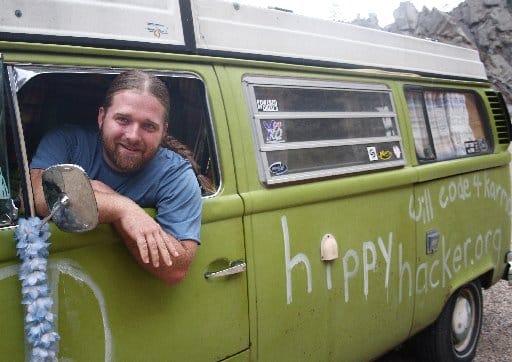
A young reporter named Lance Vaillancourt walked up to my bus one afternoon in Boulder. He was writing for the Daily Camera, covering campus life at CU. I was parked somewhere on the west end of Pearl Street. He asked if he could interview me, and I said sure!
What came out of that conversation became the article below. I've carried it with me for sixteen years — not physically, but in the sense that everything I've done since then grew from the ideas I was trying to articulate that day.
Originally published in the Boulder Daily Camera on August 14, 2009, by Lance Vaillancourt.
You may have seen it cruising around Boulder: a 1979, avocado-green Volkswagen Kombi bus with the words "Hippy Hacker" scrawled on the sides in white shoe polish.
Chris McClimans, owner of the hard-to-miss van and the titular Hippy Hacker, on Thursday acknowledged that although he's had his van marked up for several months, he only recently discovered that "hippie" is spelled with an "ie" at the end.
That was Wally — a '79 VW Westfalia. The shoe polish was permanent enough to last the summer, temporary enough to feel honest. I never did fix the spelling. It didn't matter. What mattered was what was written on the other side of the bus: "will code 4 karma."
No matter; McClimans isn't your average hippie.
While McClimans has long hair and a beard, owns a VW bus, is devoted to living in moderation and actively seeks to better the lives of his fellow man, his supreme knowledge of computers and a self-employed job as an IT security programmer and Web developer keep the rest of his roots grounded firmly in cyberspace.
I'd already started a ISP from scratch, worked at EDS in a think tank during the 1999-2000 drama, network security R&D lead for Bank of America, and my friend were confused when I was like…. I’ve done enough. The wanted me to pursue the amazing opportunity’s life had given me. But I just want to grow my hair long, find myself a hippie chick, and make some humans of my own.
"How do I make a living?" became "How do I make a life?"
"Most people accumulate wealth over the course of their life and then use it for philanthropy in their later years," McClimans said. "I didn't want to wait. So for every hour of consulting work I do, I match that with an hour working with a nonprofit entity."
This was the core idea. Not a business plan — a life plan. Match every paid hour with a volunteer hour. One-to-one. It seemed radical at the time, but the math was simple: if you need less, you can give more.
Within three years the ratio shifted to 60/40 in favour of giving. Within a decade it stopped being a ratio at all — it became a way of being.
The idea of mixing nonprofit work in with his security consulting and Web development services came to McClimans after 12 years of doing the same job for large banks, which paid handsomely, but, as McClimans put it, never gave anything back.
"I looked at my education and what I've done, and the amount of effort I need to put into creating a large amount of wealth is low," McClimans said. "I want to have enough money to live meagerly."
"Live meagerly" wasn't aspirational. It was literal. Within a year of this article, my wife and I would be living in a campervan, making our way from Colorado to Austin. We sold that van to our friend Phil Aulie for a six pack of beer. Phil turned it into a spoken word piece at the Austin Poetry Slam.
The thing about choosing to live with less is that it allows you to go where you feel a called, and respond to invitations at a moments notice and give you full attention. When my wife and I got married, we focused to have a simple focus for our new life together: “Exemplifying an abundant life”. Not trying to show off how to get more… but being on example by give more… viral generosity.
According to McClimans, this means enough money to keep his bus going from place to place and to keep him and his dog fed. He even said he'll be leaving his apartment soon to begin living out of the bus, a situation he's no stranger to.
In fact, the bohemian lifestyle is how he found Boulder in the first place.
After acquiring the bus, McClimans spent months going from town to town — staying for days at a time in his bus and visiting various people before moving on. This brand of travel brought him to Boulder a few times, until his most recent visit nearly a year ago made him decide to stay.
Sixteen years later, I'm still traveling. My family and I now live full-time in an RV, moving from place to place. The bus became a campervan, then a caravan in New Zealand on the beach, and eventually a 75 foot fifth wheel truck and trailer combo weighing 16 tons The technology evolved from USB sticks to Kubernetes clusters to wild local LLMs. But the pattern hasn't changed: go where the people are, bring what you can carry, build something together.
"Boulder is one of the reasons I've stayed around," he said, referring not only to the beautiful scenery but also to the large number of humanitarian causes available for his business model. "Boulder has a larger percentage of nonprofit organizations per capita than other communities."
The more nonprofit groups, the better, says McClimans, because it increases the possibility that he can find for-profit organizations with a nonprofit counterpart in mind for him to contract the additional work.
"What I'm trying to do is not create competition," he said, "but instead do the opposite."
"The opposite of competition." That's the sentence that became ii.coop. Not instant infrastructure. Not a technology company. A cooperative. Two lowercase i's — two people, working together. The domain is .coop because that's what it is.
And, when for-profit businesses and nonprofit businesses can help further each other's causes through the work McClimans does for them, everybody wins.
"If I can get it to where I'm working 15 to 20 hours for-profit and 15 to 20 for non," he said, "then I'll be at a point where I'm working a full week, sustaining myself, and contributing back to my community."
Looking back from 2009, I couldn't have predicted where this would lead. Within three years I'd be teaching kids in Cambodia to use computers in their own language. Within five, I'd be deploying data centers for medical ships in New Zealand. Within ten, I'd be helping define what "the cloud" means globally through the Kubernetes conformance program at the CNCF.
None of that came from a business plan. It came from showing up with what I had — a bus, a laptop, a willingness to match every paid hour with an hour of giving — and trusting that cooperation would take it further than competition ever could.


Member discussion